
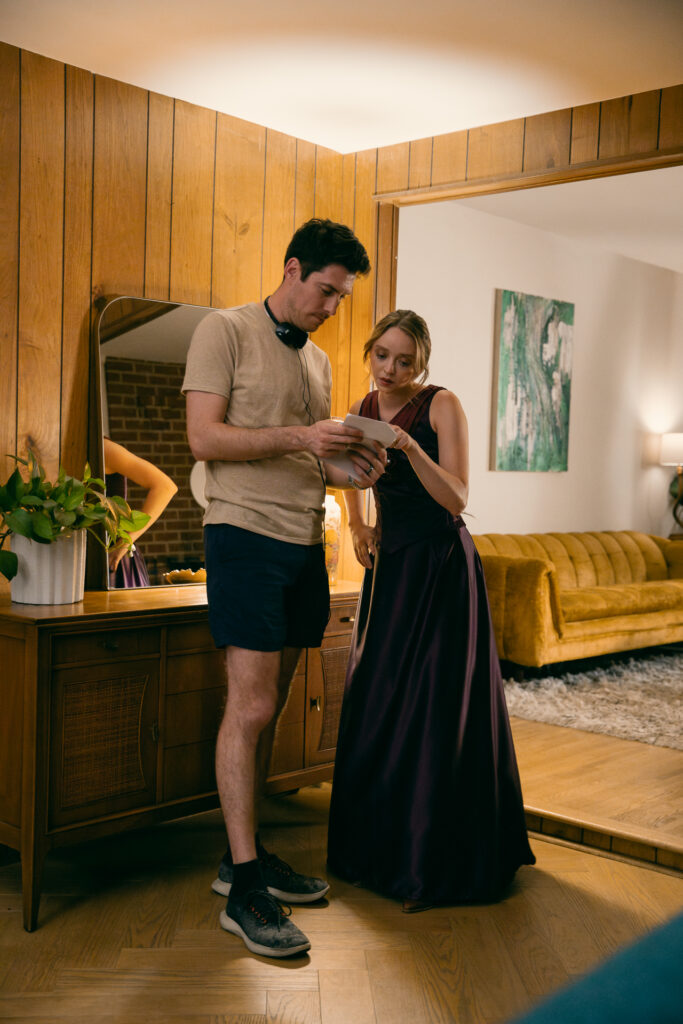
Director's Statement
by Jacob Combs
Today’s tradwife influencer phenomenon is really the most recent manifestation of a much older political project. Over and over, from the 50s to the 80s to the early 2000s, women have been told they’ll be happier if they just stay at home and make their husband and family their primary focus. Now they’re being sold that idea again.
When I first read the script of TRADWIFE, it jumped out to me because I once fell into a pseudo-tradwife dynamic myself. When my husband was in medical residency, I became a househusband, doing almost all the domestic labor. To my surprise, I actually found it really satisfying.
The experience led me to an unsettling realization: It’s so tempting to get lost in thinking about someone else’s happiness and catering to their every need, rather than figuring out what you need. So making a film about a tradwife isn’t speculative for me. It’s deeply personal.
The other reason I was so excited to direct TRADWIFE is that I’m a theater kid to my core. Threading the protagonist’s journey through Henrik Ibsen’s classic play “A Doll’s House” underscores the timelessness of the struggle for women’s self-determination that is central to TRADWIFE. Even though “A Doll’s House” is almost 150 years old, its story about a woman making the radical choice to prioritize herself over her husband and children feels so timely, and in direct conversation with our current moment.
Right now, questioning traditional gender roles feels more controversial and dangerous than it has at any point in my lifetime. But as a queer man, my entire existence is a rejection of traditional gender roles. And my personal journey has been one of asking myself again and again, ‘how can I belong to me and not to the expectations I think others have of who I’m meant to be?’
I hope this film inspires audiences to ask that question of themselves, because for me, TRADWIFE is a call to action: it’s never too late to reclaim our agency. Amidst the noise and judgments of social media and internet culture, we can often feel like we’re playing to some ‘audience’ we have to keep happy. But too often in these online spaces, nuance is flattened and people are reduced—or reduce themselves—to stereotypes.
TRADWIFE is about breaking free of those shackles. It’s about recognizing that while we are all, in a way, performers on the stages that are our lives, we can choose to prioritize the only audience that truly matters: our inner selves.